
You’re not an imposter, you were just never taught this.
There’s a moment most designers recognise. You present your work with the utmost confidence: research is evidence-based, strategy is sound and the design solution is brilliant.
All going well until the conversation moves to budget.
Your confidence evaporates and suddenly you’re apologising for your own expertise.
Worried your fees are too high, or maybe too low. Honestly, you’re not sure which is worse.
That’s not imposter syndrome. That’s a knowledge gap. And it’s not your fault.
Design degrees are extraordinary at teaching craft. Colour theory, typography, visual communication, design thinking … all of it. But the business of design? Pricing strategy? How to have a confident conversation about money? Almost nowhere on the curriculum.
So most designers do what makes sense. They guess. They look at what competitors charge. They quote what they think clients can afford. They hope for the best.
And then they wonder why they’re busy but not profitable
Here’s what we’ve learned from over a decade mentoring Australian designers
The designers who struggle most financially are rarely the weakest creatives.
They’re often the most talented.
The ones who care deeply about their work.
The ones who feel uncomfortable “selling themselves.”
Sound familiar?
The problem isn’t your design skills. It’s that pricing isn’t instinctive … it’s a system. And without a system you’re essentially running a business on gut feeling and crossed fingers.
The confidence gap is real … but it’s fixable
We’ve watched designers transform their businesses not by getting better at design … they were already good … but by understanding three things:
- What their business actually costs to run. Most designers genuinely don’t know their true hourly cost. Not a guess. Not what competitors charge. Their actual cost, including super, WorkCover, salary, software, downtime, and every other expense that quietly erodes profit.
- What to say when clients push back. The moment a client says “that’s more than we expected” most designers crumble. Not because they’re weak … because nobody ever gave them the words. Having a script isn’t manipulative. It’s professional.
- Why clients make decisions. Pricing isn’t purely rational. Clients aren’t spreadsheets. Understanding the psychology behind how people perceive value completely changes how you present your fees … and how often they’re accepted.
So what?
None of this is complicated. It’s just not taught
That’s exactly why we built the Costing, Pricing and Profit Toolkit. Not another generic business course. Not American sales tactics repackaged for Australian designers. Just practical tools built by practitioners who ran a successful Australian design studio for over 30 years … and made every pricing mistake along the way.
It includes a proper costing calculator built for Australian conditions, conversation scripts for every awkward money moment, a guide to the psychology of pricing, and a three-tier pricing system that changes how clients respond to your quotes.
The whole toolkit is $100. Once off. No subscription.
If you’ve ever felt like an imposter discussing your fees … you’re not. You just need the system everyone else forgot to give you.
Buy the (tax deductible) Costing, Pricing and Profit toolkit here.
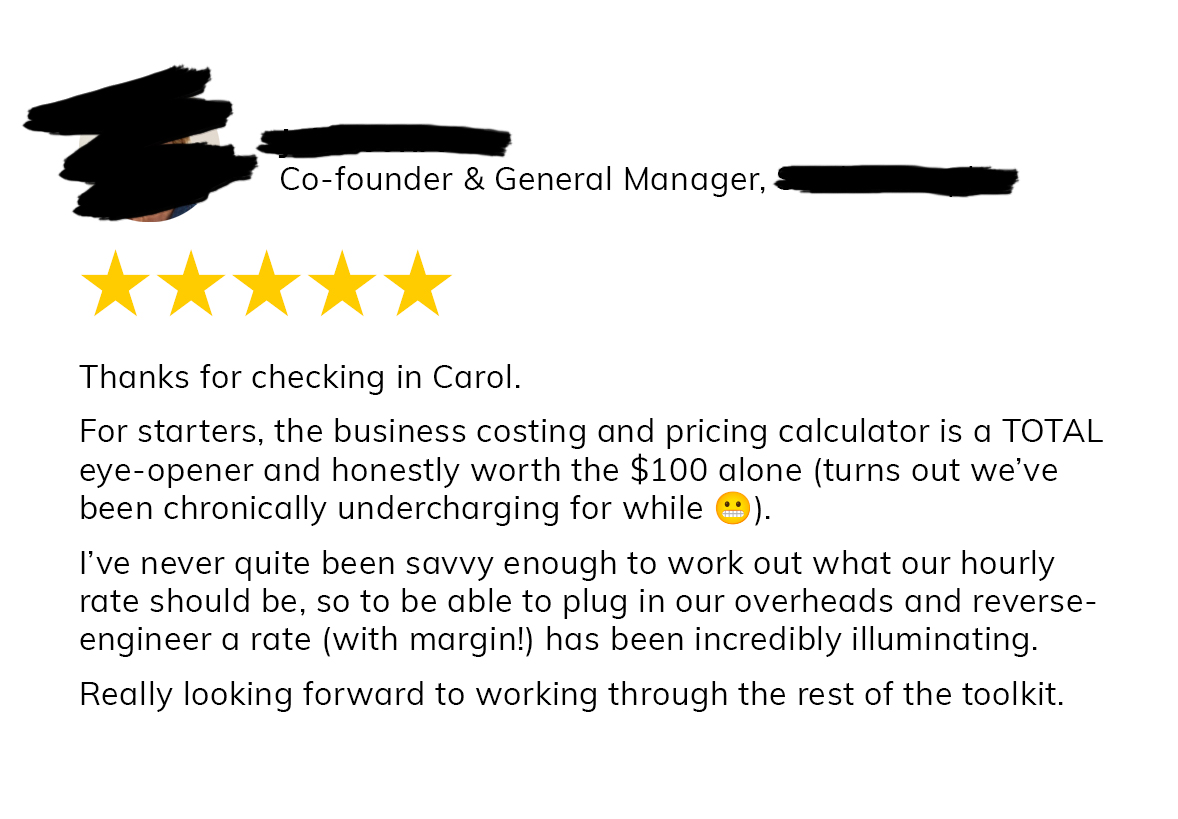
As always, happy to discuss further, just email Carol
Carol Mackay
Want more insights like this? Subscribe below. (And tell your friends 🙂)
The Design Business Review is Australia’s only online design management magazine. It’s professional development information written specifically for Australian designers by Australian designers. Best of all, it’s free.
Related articles about clients
Lastest research about clients
What to say when client’s say I need to think about it
Why some great ideas get rejected
About Carol
If you’re a female founder looking for a female business mentor to help bridge that gap between design and business, you’ve found what you’re looking for.
I love that intersection. I co-founded and built a 30+ year career building a successful, sustainable design studio. My clients included Ombudsman schemes, the Emergency Services sector and the Courts. My special power has always been an ability to use design to translate the difficult to understand or the unpalatable message.
I now use exactly the same skills with creative business owners. I translate the indigestible into bite-sized chunks of information. I share insights, introduce tools and embed processes to help others build confidence business decision-making skills. More confidence makes it easier to grasp opportunities. More confidence makes it easier to recognise a good client from the bad.
Outside DBC I have mentored with Womentor, AGDA The Aunties, and most recently Regional Arts NSW.
And I’m a proud volunteer and board member of Never Not Creative.
Always happy to chat, I can be contacted here.
